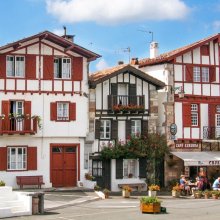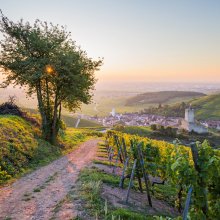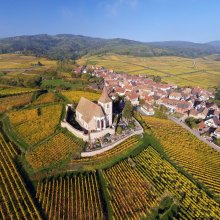
Every July, the Tour de France gives the world a moving postcard of France’s beauty. You may turn on the TV for the cycling, but soon you are seeing much more than the race: hilltop villages, mountain passes, sunflower fields, vineyards, castles, river valleys, and the cafés where locals gather to watch the riders fly past.
For some travelers, this is when a future trip to France starts to take shape.
You see a road winding through the Pyrenees, a medieval town in the Dordogne, or the vineyards around Bordeaux, and you think: I would love to go there one day.
The good news is that you do not need to be a serious cycling fan to enjoy the places made famous by the Tour de France. In fact, the best way to use the Tour as travel inspiration is often to slow it down. Instead of trying to follow the race, choose the landscapes and towns that caught your eye on TV, then build them into a thoughtful self-drive itinerary at your own pace.


At a glance: how to use the Tour de France as travel inspiration
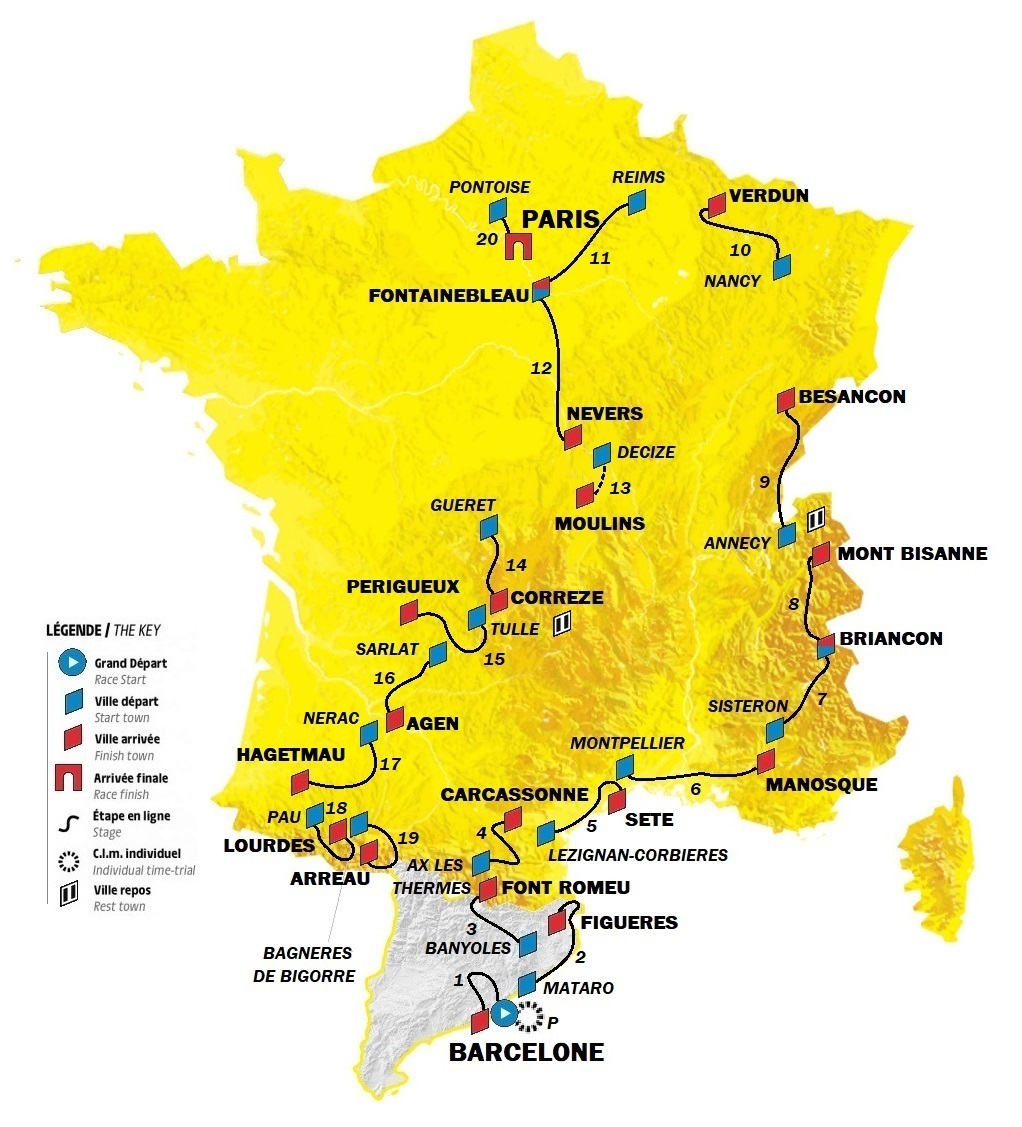
The Tour de France route changes every year, which means it regularly shines a spotlight on different regions of France (and recently even in neighboring countries. The current race runs from July 4 th to July 26 th, starts in Barcelona, returns to France through the Pyrenees, and finishes in Paris. The official route includes 21 stages and passes through 7 French regions and 29 departments.
In 2027, the Tour starts in Scotland, going through northern England and ending in Cardiff before taking up in France.
And in 2028, the starting point is Reims, the capital of Champagne.
As you watch, notice the places that appeal to you most:
- Do you love the mountain scenery? Look at the Pyrenees or the Alps.
- Do you prefer villages, markets, and food? Consider the Dordogne, Alsace, Burgundy, or the Loire Valley when they appear on or near the route.
- Are you drawn to vineyards and elegant towns? Bordeaux, Burgundy, Champagne, and Lyon may be a better fit.
- Would you enjoy the atmosphere of the race itself? Plan to see one stage in person, but do not build your whole trip around chasing the peloton.
A little history: how the Tour de France began
The Tour de France was not created as a tourism campaign, although it has become one of the most powerful showcases for France’s landscapes. It began as a bold newspaper idea.
In 1903, journalist Géo Lefèvre suggested to Henri Desgrange, editor of the sports newspaper L’Auto, that they organize a race in stages around France. At the time, L’Auto was competing with another sports newspaper, Le Vélo, and the race was partly a way to capture public attention. Desgrange reportedly thought the idea was wild at first, but he was eventually convinced.
The first Tour de France set off on July 1, 1903, from Montgeron, just outside Paris, with 60 cyclists gathered in front of the café Le Réveil-Matin. It is hard to imagine now, when the Tour is broadcast around the world, but the early race was raw, exhausting, and very long by modern standards. Riders covered huge distances on heavy bicycles, often on rough roads, with far less support than today’s professional teams.
From the beginning, the Tour was about more than speed. It was about tracing the shape of France, connecting towns and regions, and creating a national story that French people could follow day by day.
The mountains changed everything
If the early Tour was already demanding, the mountains made it legendary.
The Pyrenees entered Tour history in 1910, when the race tackled high passes including the Col du Tourmalet. The official Tour archives note that even Henri Desgrange hesitated before including such a difficult pass, and the 1910 edition started with only 110 riders.
Today, when you see helicopter shots of riders climbing through the Pyrenees or Alps, you are watching one of the great traditions of the race. These mountain stages are beautiful on TV because the scenery is dramatic, but they are also deeply tied to the Tour’s identity: effort, endurance, weather, crowds, and the long road upward.
For a future trip, this does not mean you need to cycle up a mountain pass. You might simply drive through the foothills, stop in a spa town, enjoy local cheeses, or spend a few nights in a mountain village. The Tour can introduce you to these regions, but your trip can be much more relaxed.

©
CC0
The story behind the yellow jersey
The most famous symbol of the Tour de France is the yellow jersey, or maillot jaune, worn by the rider leading the overall race. It first appeared in the Tour on July 19, 1919, on the shoulders of French rider Eugène Christophe.
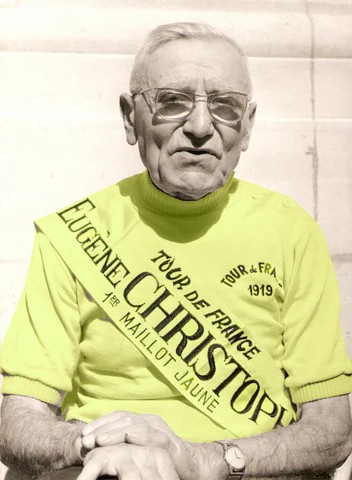
Eugène Christophe in the Maillot Jaune
©CC0
The yellow color is often linked to the yellow paper on which L’Auto, the newspaper behind the Tour, was printed. Over time, the jersey became one of the most recognizable symbols in world sport.
For travelers, the yellow jersey is a reminder that the Tour is both a sporting event and a piece of French cultural history. In many towns, you will see yellow decorations, bicycles in shop windows, banners across streets, and local pride on full display when the race comes through.
Places you may spot on TV — and how to visit them more slowly
One of the pleasures of watching the Tour de France is discovering places you may not have considered before. Some will be famous; others may only appear for a few seconds as the peloton passes through. These glimpses can become wonderful starting points for a future itinerary.
The Pyrenees: for mountain scenery with less crowds than the Alps
The Pyrenees are often one of the most dramatic parts of the Tour. On TV, you may see steep green slopes, stone villages, grazing sheep, and twisting roads that look almost impossible from above.
For a trip, the Pyrenees work well if you love nature, scenic drives, local food, and a slower rhythm. You can enjoy the regional pride of the Basque Country, enjoying mountain valleys, visit small markets, or include a gentle walk rather than a serious hike. There are also elegant seaside towns like Biarritz and nice beaches famous for surfing.
Dordogne: villages, rivers, markets, and deep history
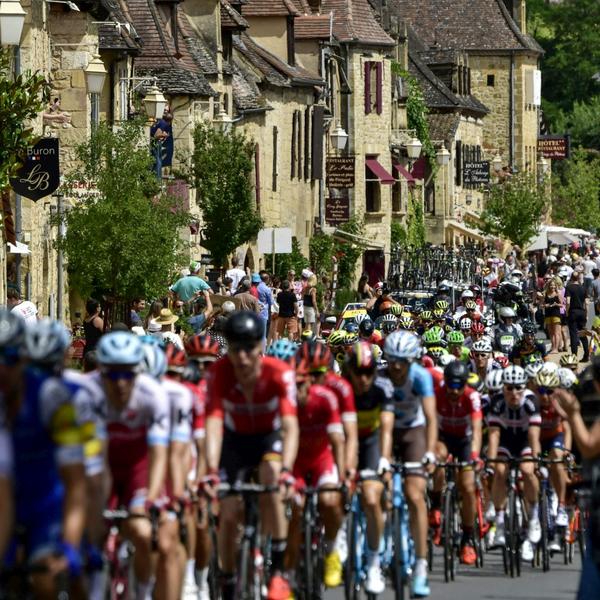
When the Tour passes through or near the Dordogne, the scenery is softer but just as memorable: honey-colored stone villages, wooded valleys, rivers, castles, and market towns.
This is a wonderful region for travelers who enjoy history, food, and village life. You can visit prehistoric caves, canoe on the Dordogne River, stroll through a market in Sarlat, or enjoy a long lunch with duck, walnuts, strawberries, and local wine. It is also a region where a self-drive trip makes sense, because many of the best places are spread out across the countryside.
Bordeaux and southwest France: vineyards, elegant towns, and Atlantic air
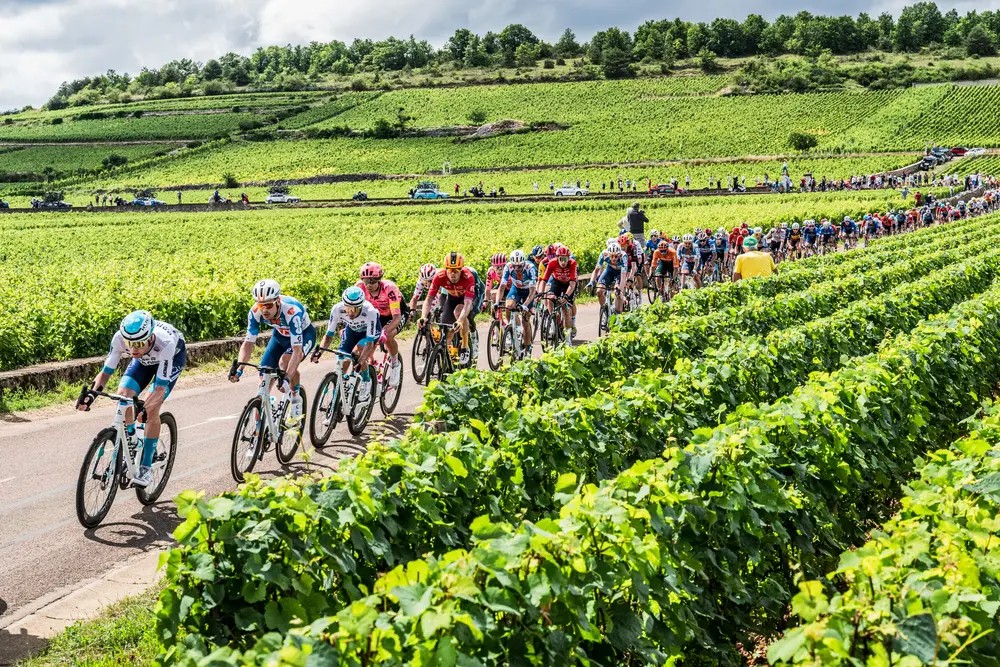
Bordeaux often appears on or near Tour routes, and it is one of France’s great gateways to the southwest. If the TV coverage shows vineyards, wide rivers, and elegant stone buildings, this may be your sign to look more closely at the region
A future trip could include Bordeaux itself, Saint-Émilion, the Médoc vineyards, the Arcachon Bay, or the Atlantic coast. This is a good choice if you want a mix of wine, food, architecture, and relaxed driving days.
Alsace, Burgundy, and the east: half-timbered villages and quiet roads
When the Tour heads east, the scenery changes again. Alsace offers colorful half-timbered villages, vineyards, storks on rooftops, and a culture that feels both French and distinctly regional.
Burgundy is quieter and visiting the famous wine villages nestled in the vineyards is a dream come true for any wine aficionado.
These regions are excellent for travelers who want authentic France beyond the most obvious routes. They also pair well with Champagne, the area around Verdun, or the Alps depending on your time and interests.
Paris: the famous finish, but not always the easiest Tour experience
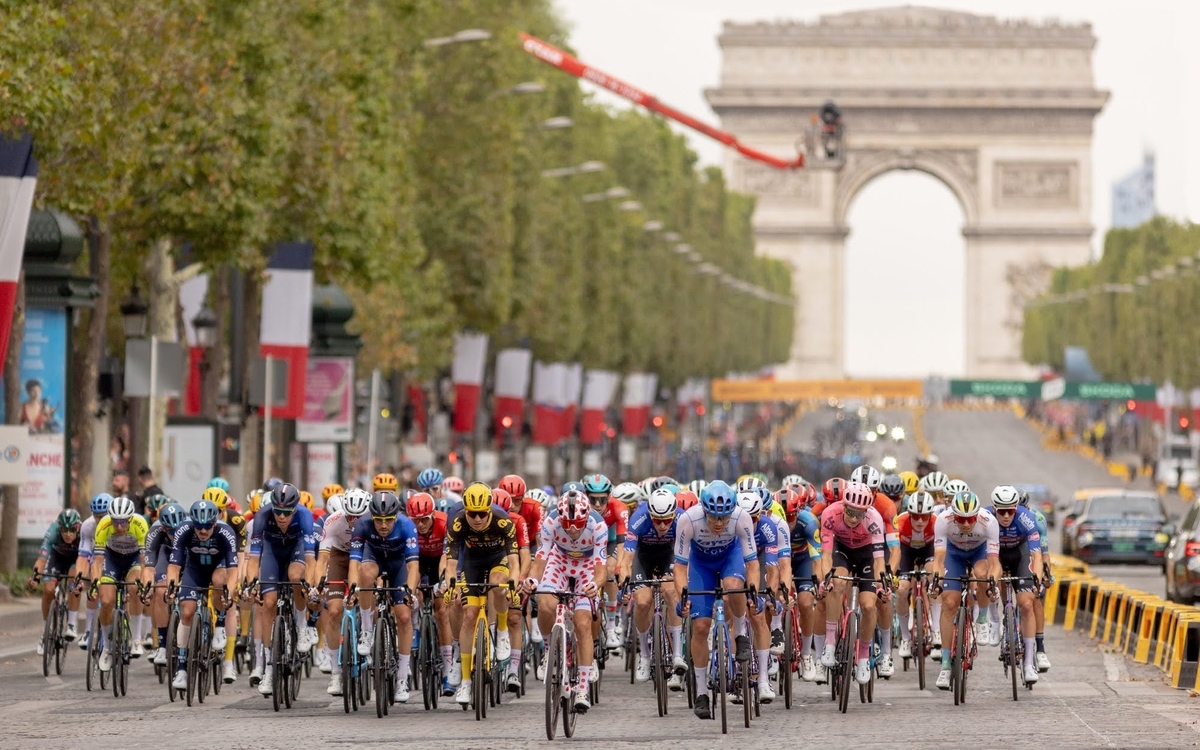
The Tour traditionally ends in Paris, and the 2026 official route finishes on the Champs-Élysées. Watching the final stage on TV is exciting: the monuments, the wide avenues, the Arc de Triomphe, and the sense of celebration.
Seeing the finish in person can be memorable, but it is also crowded and logistically restrictive. If you prefer comfort and flexibility, you may enjoy watching the Paris finish from a café or your hotel, then exploring the city at a calmer moment the next day.



Should you plan a trip around the Tour de France?
You can, but we recommend doing it carefully and with intention.
The Tour is exciting, but it also brings road closures, traffic changes, fully booked accommodations, and large crowds in certain towns. Race day can involve a lot of waiting, walking, heat, and uncertainty. That can be part of the fun, but only if you are prepared for it.
For most independent travelers, the best approach is to include one Tour moment rather than trying to follow the race every day. Choose a stage start, a village along the route, or a scenic area where you would enjoy staying anyway. Spend two or three nights nearby, keep the race day light, and plan something quieter afterward.
A stage start can be especially enjoyable for first-time spectators. You may see the teams, bikes, support vehicles, and local festivities without needing to stand for hours on a mountain road. A village passage can also be a lovely local experience if you arrive early and are patient after the riders pass.
What to remember when watching the Tour from home
As you watch the Tour de France on TV, keep a notebook or open a map. Write down the places that make you pause. Not every town on the route will be ideal for your future trip, but patterns will appear quickly.
You may realize that you are drawn to mountain landscapes, or to small villages, or to vineyard country, or to coastal roads. That is useful information to share with your travel planner. A beautiful France itinerary should be designed around what genuinely interests you, not around a list of places everyone else says you “must” see.
The Tour is a wonderful travel inspiration tool because it shows France in motion. It reminds you that the country is not only Paris, Provence, and the Riviera. It is also market squares, quiet valleys, regional cheeses, local accents, summer festivals, and roads that lead from one landscape to another.
How France Just For You can help
At France Just For You, we design personalized self-drive trips for travelers who want to explore France independently, with local support and thoughtful planning behind the scenes.
If the Tour de France has inspired you to visit a region you saw on TV, we can help you decide whether it fits your travel style, how long to stay, where to base yourself, and what to include nearby. We can also help you avoid the common mistakes: trying to cover too much ground, underestimating driving times, or planning a busy sightseeing day when roads may be affected by the race.
Your trip does not need to follow the Tour exactly. It can take the best of what the Tour reveals — the landscapes, villages, food, history, and local atmosphere — and turn it into a slower, more personal journey through France.
Browse our self-drive tours in France, complete our trip-planning form, or email us at travel@france-justforyou.com. We would be happy to help you turn your Tour de France inspiration into a tailor-made trip designed around you.
If you would like to share with us some of the places you loved while watching the Tour de France, contact us to start shaping your own Tour de France.
Tell us more about your trip to France
FAQs
Can I visit places I saw on the Tour de France route?
Yes. Many towns, villages, and regions shown during the Tour can be included in a future self-drive itinerary. The key is to choose the places that match your interests and pace, rather than trying to copy the race route.
Is it worth seeing the Tour de France in person?
Yes, if you enjoy local atmosphere, outdoor events, and a bit of unpredictability. It is not the best fit for travelers who dislike crowds, heat, waiting, or road closures. For many people, seeing one stage is enough.
What is the easiest way to see the Tour de France during a trip?
A stage start or a town along the route is usually easier than a famous mountain climb. Mountain stages are spectacular, but they often require more walking, earlier arrival, and greater flexibility.
Which regions are best for a Tour de France-inspired trip?
The Pyrenees, Dordogne, Bordeaux region, Alsace, Burgundy, and the Loire Valley can all work beautifully, depending on the route and your interests. The best region is the one that fits the kind of France you want to experience.
Do I need to cycle to enjoy a Tour de France-themed trip?
No. You can enjoy the Tour’s landscapes by car, on foot, through local markets, scenic drives, wine tastings, village visits, and regional food experiences. The race can inspire the route, but the trip can be entirely your own.