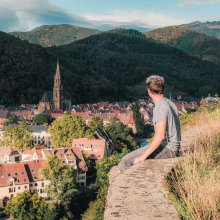
An Alsace road trip is one of the easiest and most rewarding ways to explore this region of eastern France.
Just looking at photos of Alsace — the half-timbered houses, the flowers spilling out of window boxes, the vineyards running right up to the edge of medieval villages — is enough to make anyone want to see it in person.


Alsace Road Trip: Quick Overview
- Best base: Colmar
- How many days: 3 to 5 days
- Best time to visit: May, June, September (or December for Christmas markets)
- Do you need a car? Yes — it’s the most practical way to explore the region and move easily between villages
- Best for: travelers who enjoy villages, wine, and short scenic drives
Last year, I visited the region and saw for myself what makes this part of eastern France so appealing — not just the scenery, but the sense of history running through it.

With more than 70 villages spread along the wine route, the real question is how to plan an Alsace road trip so it doesn’t feel rushed, while still including what makes the region special.
The route itself runs for around 170km (just over 100 miles) from north to south. Although that sounds like a lot, the distances between stops are short — often just 10 to 15 minutes by car. What tends to take longer is deciding where to stop, how long to stay, and how to balance time in the smaller villages with places like Colmar, Strasbourg, and the wider region.
At France Just For You, we plan self-drive itineraries through Alsace regularly, and the advice we give our travelers is always the same:
- Slow down and travel at a pace that feels comfortable to you
- Choose a few villages rather than trying to see them all
- Leave room for unexpected discoveries along the way
These might include a winery you stumble across, a bakery that stops you in your tracks, or a view from the vineyards that makes you pull the car over. We include our favorites in every Alsace itinerary we plan.
This post covers how to structure an Alsace road trip, which villages we recommend visiting, what to know about Alsace wine before you go, and how to avoid the most common planning mistakes (such as trying to see too much in too little time!).




What Is the Alsace Wine Route?
The Alsace wine route is the oldest wine route in France, established in 1953. It runs for over 100 miles from Marlenheim in the north to Thann in the south. It passes through over 70 villages as it winds through the foothills of the Vosges mountains, with vineyards on one side and the Rhine plain stretching toward Germany on the other.
The villages along the route are among the most beautiful in France, with well-preserved medieval features, cobblestone lanes, fortified walls, and architecture that looks quite different from anywhere else in the country. These are all clues to Alsace’s history.
The region has changed hands between France and Germany several times over the centuries, and the Germanic influence is visible everywhere: in the half-timbered houses, in the food, in the place names, and even in the local dialect. But be in no doubt – when I was there, the people made it clear that they are proudly French!
In practice, an Alsace road trip doesn't feel like a typical French wine tour. The region has such a distinct identity that you may feel like you’re in the midst of a Brothers Grimm tale as you stroll through the villages! But the wine is, indeed, excellent – and if you book a tour of Alsace with us, we’ll tell you our favorite places to taste it!

©
What to Know About Alsace Wine
Around 90% of Alsace's wine production is white, and unlike many French wine regions, the wines are labeled by grape variety rather than by appellation, which makes them easier for visitors to navigate. You don't need to be a wine connoisseur to enjoy the Alsace wine route, but knowing a few things beforehand makes the experience more interesting.
The main grape varieties you’ll come across are:
- Riesling — the flagship grape. Typically dry, mineral, and more structured than the sweeter styles many people associate with German Rieslings. If you think you don’t like Riesling, it’s worth trying it here.
- Gewürztraminer — aromatic, floral, and slightly spicy. It pairs particularly well with local dishes and strong cheeses like Munster.
- Pinot Gris — richer and rounder, often with more weight and complexity.
- Pinot Blanc — lighter and more approachable, with fresh apple and pear notes. A good place to start if you’re new to Alsace wines.
- Crémant d’Alsace — the region’s sparkling wine, made using the traditional method. Excellent quality and generally more affordable than Champagne.
- Pinot Noir — the only red grape in Alsace AOC wines. Usually lighter in style, though some producers are now making more structured reds.
While most everyday wines are dry, Alsace also produces sweeter styles. Look out for:
- Vendange Tardive (late harvest)
- Sélection de Grains Nobles (rich dessert wines made from botrytized grapes)
Many producers now indicate sweetness levels on the label — sec, demi-sec, moelleux, doux — which makes things easier when choosing a bottle.
Wine tastings in Alsace are generally informal and welcoming. Many producers are small, family-run wineries where you can often walk in and taste several wines (though some estates now recommend booking ahead, especially in peak season). In Alsace, you'll often find yourself chatting with the winemaker directly.
We include specific winery recommendations in each traveler's personalized travel guidebook. These are places we've visited ourselves and where we know our travelers will have a good experience. It's one of the things that makes having a local team plan your trip worthwhile, because the best producers aren't always the most visible ones.

©
FJFY
How Many Days Do You Need in Alsace?
For an Alsace road trip, most travelers need 3 to 5 days. The exact length depends on whether you're visiting Alsace on its own or as part of a longer self-drive tour of France.
3 to 4 days
Enough to visit Colmar, drive part of the wine route, and explore a few villages. This works well if Alsace is one stop on a longer itinerary — for example, as part of a Northern France road trip itinerary.
5 to 7 days
Gives you time to explore more of the wine route, spend a day in Strasbourg, visit Haut-Koenigsbourg Castle, and enjoy quieter walks through the vineyards. This is the pace we recommend for most travelers.
2 to 3 days (short trip)
A long weekend from Paris is possible. The TGV from Paris to Colmar takes under three hours, and you can rent a car on arrival. Focus on Colmar and nearby villages.
The most common mistake is trying to visit too many villages in one day. In practice, three is a comfortable maximum. Beyond that, they start to blur together — and you spend more time parking and walking than actually enjoying the places themselves.
Planning fewer stops and allowing time to explore each one properly usually leads to a much more enjoyable trip.

©
Unsplash
Colmar or Strasbourg: Where Should You Base Yourself?
For an Alsace road trip, Colmar is the best base. It’s centrally located on the wine route, with the main villages within a short drive. Strasbourg is worth visiting, but works better as a day trip or overnight stop.
Colmar vs Strasbourg
- Colmar: best base for exploring the villages; smaller, quieter, more practical for driving
- Strasbourg: larger city, famous cultural sights; better as a day trip or overnight stay
Colmar is right in the middle of the best section of villages — Eguisheim, Riquewihr, Kaysersberg, and Ribeauvillé are all within 15 to 30 minutes by car. Colmar itself is beautiful and very walkable, with its canal-side Little Venice district, the Unterlinden Museum (home to the remarkable Isenheim Altarpiece), and the Covered Market, which is perfect for picking up cheese, charcuterie, and bread for a picnic in the vineyards. It's smaller and more manageable than Strasbourg, and it has a quieter, more relaxed feel. This is why we prefer it as a base for exploring the villages.
Colmar does get busy in summer and during the Christmas markets, but timing makes a big difference. Weekdays, mornings before 10am, and late afternoons are when you'll have the prettiest streets largely to yourself. And the surrounding villages, which are just a short drive away, are much quieter.
Find out more about things to do in Colmar.


Strasbourg is a bigger city with a different energy. It's the capital of the region and has a grand historic center — the Gothic cathedral, the Petite France district with its canals and half-timbered houses, and a more cosmopolitan feel with university students and international workers. Strasbourg also has a livelier restaurant and bar scene than the wine villages, and an international feel from hosting the European Parliament. It's very walkable, and the historic center on the Grande Île is a UNESCO World Heritage Site.
However, we wouldn't recommend basing yourself here if you want to explore the Alsace wine route and the villages. Most of the key stops are 45 minutes to an hour south, which would add driving time to each day.
Find out more about things to do in Strasbourg.


Our recommendation: Base yourself in Colmar for the wine route, and visit Strasbourg as a day trip or as a stop at the beginning or end of your Alsace road trip. If you have five days or more, spending two or three nights in Colmar and one or two in Strasbourg gives you the best of both.
The Best Villages on the Alsace Wine Route
Villages we often recommend to France Just For You travelers include Eguisheim, Riquewihr, Kaysersberg, Ribeauvillé, Turckheim, and Obernai. All are small enough to explore on foot in an hour or two, and because they're so close together, you can comfortably visit two or three in a day with time for a wine tasting or a long lunch in between.
The following villages are listed roughly from south to north along the route. You can read more about each one in our guide to villages in Alsace.
Eguisheim
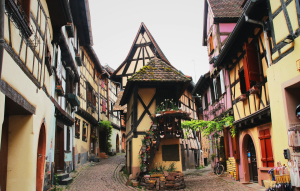
Just 15 minutes from Colmar, Eguisheim is built in concentric circles around a central square, with narrow lanes that spiral outward past half-timbered houses overflowing with geraniums. It was voted France's Favorite Village in 2013, and it's easy to see why. The whole village is walkable in under an hour, but you may end up staying there longer, as there are so many things to see.
Don't miss the walk up to the Three Castles above the village for panoramic views of the vineyards and the Rhine plain. It's about a 10-minute drive to the parking area and then a short hike. Try to go early in the morning or late in the day, especially in summer.
Turckheim
A peaceful, flower-filled village that gets far fewer visitors than its neighbors. In summer evenings (May through October), Turckheim still has a Night Watchman who makes his rounds through the village — a centuries-old tradition kept alive by locals. It's a lovely, low-key stop on the wine route, and a good contrast to the busier villages.
Kaysersberg
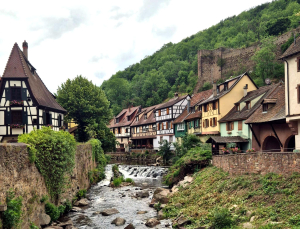
Set in a green valley overlooked by castle ruins, Kaysersberg was voted France's Favorite Village in 2017. The stone bridge over the Weiss River is one of the most photographed spots in Alsace, and you can climb up to the castle for sweeping views of the village and surrounding landscape. Kaysersberg has a relaxed pace that makes it a good place to stop for lunch at a winstub (a traditional Alsatian tavern) and try choucroute or tarte flambée.
Kaysersberg is absolutely worth visiting and is walkable. The whole village center is pedestrianized, so you can explore it entirely on foot.
Riquewihr
Enclosed by medieval walls and vineyards, Riquewihr looks much as it did in the 1500s. It's one of the most visited villages on the Alsace wine route, and it can get crowded by mid-morning when the day-trip coaches arrive. The trick is to arrive early — try to be there when the bakeries open around 7am, or at least before 8.30am — or come in the late afternoon when the crowds thin out. Walk the main street (Rue du Général de Gaulle), climb the Dolder Tower for views across the valley, and take your time. The logical next driving stop is Ribeauvillé.
Ribeauvillé
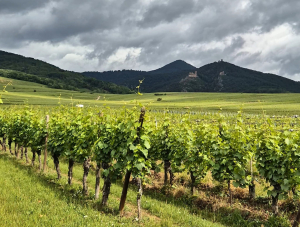
Just a few minutes' drive from Riquewihr, Ribeauvillé has a slightly different character — a longer main street, more of a lived-in feel, and impressive castle ruins on the hills above. If you're choosing between the two (a common dilemma), I'd say Riquewihr is more photogenic, but Ribeauvillé feels more like a real town. Ideally, visit both, as I did — they're close enough that you can walk between them through the vineyards via Hunawihr if you're feeling energetic (it’s about an hour’s walk).
Obernai
Further north and closer to Strasbourg, Obernai has a more elegant, prosperous feel than the smaller wine villages. The Place du Marché is surrounded by Gothic and Renaissance merchant houses, and the 13th-century Kappelturm belfry gives the town a distinctive profile. It's a good stop if you're driving between Colmar and Strasbourg, and it has one of the better Christmas markets in the region if you're visiting France in December.
What is the prettiest town in Alsace?
People ask this a lot, and the honest answer is that it depends on what you're drawn to. Eguisheim and Riquewihr are probably the most classically beautiful. Kaysersberg, with its river and castle ruins, has the most picturesque setting, with Ribeauvillé following in close second. And Colmar, though larger, is arguably the most photogenic of all, with its colorful façades and Little Venice neighborhood. The good news is that they're all close together, so you don't have to choose just one.
Beyond the Alsace Wine Route
Two worthwhile stops to add to an Alsace road trip beyond the wine villages are Haut-Koenigsbourg Castle and a walk in the Vosges mountains.
Haut-Koenigsbourg Castle is perched on a hilltop above the vineyards and offers panoramic views across the Rhine plain to the Black Forest in Germany. Built in the 12th century, destroyed, and then painstakingly restored in the early 20th century under Kaiser Wilhelm II, it's one of the most impressive castles in France. It's a 40-minute drive from Colmar and is well worth half a day.

©
J.L. Stadler, ADT Alsace
The Vosges mountains, which form the western backdrop to the wine route, offer excellent walking trails with views down over the vineyards. If you enjoy hiking, it's a wonderful contrast to the village-hopping.

©
Pxhere
The Best Time to Visit Alsace
The best months for an Alsace road trip are May, June, and September through early October, with mild weather, green or golden vineyards, and manageable crowds. Here's how the rest of the year breaks down.
May, June, and September offer long days, comfortable temperatures, and the vineyards at their most beautiful. This is when we recommend most of our travelers visit.
Late September and October bring the grape harvest and the vineyards turning gold and amber. This is a beautiful time to visit if you enjoy the fall colors, and it's generally less crowded than summer.
July and August are the busiest months. The villages can feel very crowded, especially Riquewihr and Colmar. If you visit in summer, timing matters — go early or late in the day.
December transforms Alsace entirely. The Christmas markets in Colmar, Strasbourg, Kaysersberg, and several other villages are among the best in Europe, with twinkling lights, mulled wine, and a genuinely festive atmosphere. But it's extremely popular. If you're planning a December visit, book accommodation as far in advance as possible, ideally a year ahead.
January through March is the quietest period. Some restaurants and attractions may have limited hours, the weather is likely to be cold and damp with fewer hours of daylight. But if you prefer to have the villages almost to yourself, mid to late March could be an option.


How We Plan Alsace Road Trips at France Just For You
When you're visiting Alsace with us on one of our self-drive tours of France, we design the trip around your interests, and we handle all the planning so you can focus on looking forward to and then enjoying your trip.

That means we'll suggest villages for you based on your interests — history, wine, food, walking, photography — and recommend specific wineries, restaurants, and experiences that we've tested ourselves. We'll book you into premium accommodations we know personally, arrange your car hire, and put together a personalized guidebook with your full itinerary, driving routes, parking information, and suggestions on how to spend each day.
Our travelers often tell us that the winery and restaurant recommendations are some of the most valuable parts of the guidebook. With over 70 villages on the wine route and hundreds of producers, knowing which ones are worth your time — and how to avoid the tour buses — makes a real difference.

If you'd like to explore what an Alsace road trip could look like, you can browse our Alsace itineraries, read more about our favorite Alsace villages, or complete our trip-planning form below.
You're also welcome to email us at travel@france-justforyou.com. Our expert trip planners Emilie and Laura are always happy to talk through ideas for your dream trip to France!
FAQs
How many days do you need for an Alsace road trip?
Three to four days is enough for a focused visit to Colmar and several wine route villages. Five to seven days allows you to explore the route more thoroughly, visit Strasbourg, and include Haut-Koenigsbourg castle. Most France Just For You travelers spend four to five days in Alsace, often as part of a longer trip through France.
Is the Alsace wine route worth driving?
Yes. The wine route is one of the best drives in France — the distances between villages are short (often 10 to 15 minutes’ drive), the scenery is beautiful, and having a car gives you the flexibility to stop wherever you like. Many of the smaller villages and best wineries aren't accessible by public transport.
Find out more about the Alsace wine route on the official website.
Is Colmar or Strasbourg better for an Alsace road trip?
Colmar is the better base for the Alsace wine route because it's centrally located — most of the best villages are within 15 to 30 minutes by car. Strasbourg is a bigger city worth visiting, but it's at the northern end of the route and less convenient for day-tripping to the villages. Ideally, spend most of your time based in Colmar and visit Strasbourg as a day trip or overnight stop.
What is the prettiest village on the Alsace wine route?
Eguisheim, Riquewihr, and Kaysersberg are consistently rated among the most beautiful villages in France. Each has a different character: Eguisheim is intimate and circular, Riquewihr is perfectly preserved and medieval, and Kaysersberg has a dramatic setting with castle ruins above the town. All three are within 30 minutes of Colmar.
What wines is Alsace known for?
Around 90% of Alsace's wine production is white. The main varieties are Riesling, Gewürztraminer, Pinot Gris, and Pinot Blanc. The region also produces Crémant d'Alsace (an excellent and affordable sparkling wine) and a lighter-style Pinot Noir. Unlike many French wine regions, Alsace labels its wines by grape variety rather than appellation. While most everyday Alsace whites are dry, the region also produces notable late-harvest and dessert wines.
Can you do the Alsace wine route without a car?
You can visit Colmar and Strasbourg by train, and there is a seasonal hop-on-hop-off bus that serves some villages. However, for a proper Alsace road trip with the flexibility to explore at your own pace, we strongly recommend hiring a car. We arrange automatic car hire with full insurance for all of our travelers.
If you’re concerned about driving in France, you may find our guide to driving in France as a tourist useful. In our opinion, Alsace is an easy region to drive in.
What is the best time of year to drive the Alsace wine route?
May, June, and September offer the best combination of weather, scenery, and manageable crowds. Late September and October are beautiful for the harvest and fall colors. December is magical for the Alsace Christmas markets but very busy. July and August are the most crowded months.
Can you combine Alsace with a Northern France road trip?
Yes. Alsace is the final stop on one of our Northern France road trip routes, which takes you from Paris through the Somme, Lille, and Verdun before ending in Alsace. This route works particularly well for travelers interested in World War history, combined with a completely different side of France. Read our full Northern France road trip guide for details.