Some of the best things to do in Saint-Malo include exploring the walled old town, known as Intra-Muros, visiting Saint-Vincent Cathedral, walking the historic ramparts, and enjoying the beaches along Brittany’s Emerald Coast. If you have just one day in Saint-Malo, these sights can be combined into an easy walking itinerary, with time to visit Fort National or Grand Bé if the tide permits. Below, we explain what to see, where to eat, and how to make the most of your day.
Saint-Malo fits naturally into a longer driving tour of Brittany or one of our Normandy tours that includes nearby Mont-Saint-Michel.
How to Spend One Day in Saint-Malo
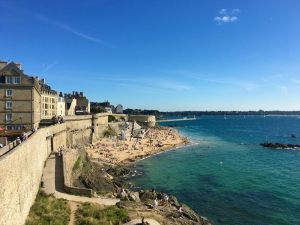
Saint-Malo’s historic center is compact, making it possible to see its main sights on foot in one day. Your plans may need to change slightly according to the weather and tides, but we recommend organizing your day as follows:
Morning: Begin inside Intra-Muros, exploring the cobbled streets inside the walled city and visiting Saint-Vincent Cathedral. Then walk around the historic ramparts for panoramic views of the coast, beaches, harbor, and offshore islands.
Lunch: Stop for a traditional Breton galette, seafood, or crêpes at one of the restaurants inside the walled city.
Afternoon: Check the tide times before deciding whether to walk to Fort National or Grand Bé. These offshore sites are accessible only when the tide permits. If they cannot be reached safely, spend the afternoon at Bon Secours Beach or walk along the Grande Plage du Sillon.
Late afternoon: Return to Intra-Muros for time to browse the shops, enjoy an ice cream, or relax at a café before continuing your journey.
The Walled City: Intra-Muros
Known in French as La Ville Intra Muros, a wander through the old town is a must when visiting Saint Malo. The historic center is very much a lived-in part of the city, with plenty of shops and services. There is some traffic, but there is limited access to particular streets. If you're traveling with France Just For You, we will tell you about some good parking spots just outside the old town if you visit Saint Malo.
The cobbled streets of the walled city are full of charm and wonderful for strolling. There are plenty of small local shops to explore, cafes and restaurants, and benches that are perfect for people-watching while you enjoy an ice cream.
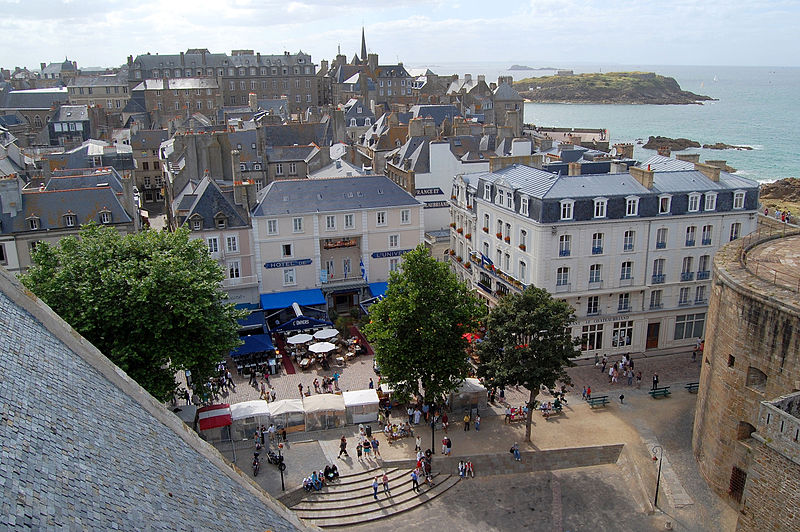
An aerial view inside the walled city of St Malo, Brittany (Pline - CC by SA 3.0)
Saint-Vincent Cathedral
Also known as Saint-Malo Cathedral, this gorgeous Romanesque, Gothic and Renaissance-style cathedral inside the walled city is well worth a visit.
It houses the tomb of Jacques Cartier, the Saint-Malo native mentioned above, who discovered Canada in the 16th century.
Some parts of the cathedral have undergone extensive renovation work following attacks on the city over the centuries. The most recent work took place over more than two decades, to repair the damage inflicted upon the cathedral by the World War II bombings. The beautiful stained glass windows are a particularly stunning sight to behold, depicting scenes from the city’s history.
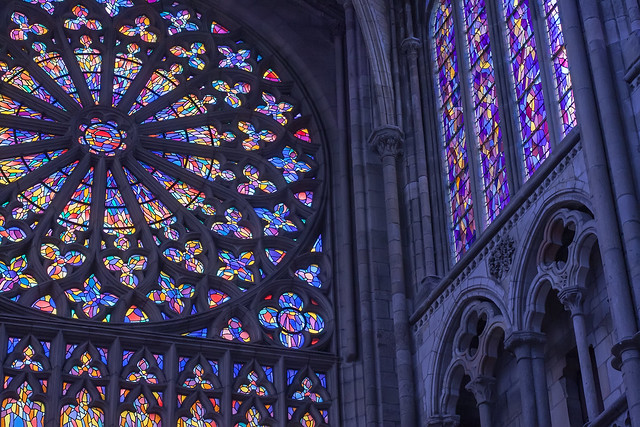
Stained glass windows in St Malo Cathedral (Flickr sagesolar CC by 2.0)
Walking the Saint-Malo Ramparts
The iconic walls surround the city of St Malo for about 2km (just over a mile). Climb up using the steps at one of the city gates or the castle and enjoy sweeping views across the sandy beaches, the Rance estuary and the harbor.
Saint-Malo’s earliest fortifications date from the Middle Ages, but much of the circuit visitors see today was reinforced and expanded during the 17th and 18th centuries. The ramparts were largely spared during the fighting and bombardment of August 1944, even though approximately three-quarters of Intra-Muros was destroyed.
It is worth planning a walk along the walls in order to appreciate this magnificent and historical seascape. You might be interested in stopping by at the Maison du Québec along the way, which offers visitors a glimpse at modern day Quebec through a photographic exhibition. It also tells the story of Jacques Cartier and how he founded ‘New France’ upon his exploration of Canada.
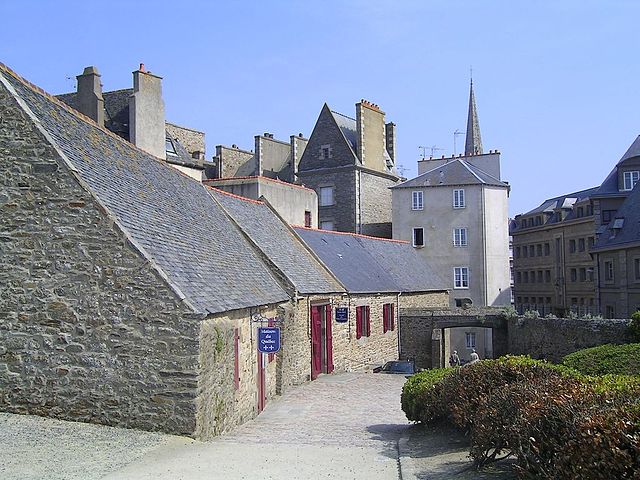
Maison du Quebec in Saint Malo (Marianna - CC by SA 3.0)
Saint-Malo’s Beaches
St Malo is famous for its beautiful sandy beaches and views of the ramparts and offshore fortresses. The Grande Plage du Sillon is a huge stretch of beach slightly away from the town that neighbors the Plage de l’Eventail and Bon Secours beach to the south (nearest to the town). It is perfect if you want to go for a stroll along the beach, heading north away from the old town.
Bon Secours Beach is right next to the walled city and can be accessed via the city walls. It is one of the best-equipped beaches, with a walled-off seawater swimming pool, a lifeguard station, refreshments and kayaking opportunities. It offers postcard views of the ramparts as well as the Vauban and Grand Bé fortresses.
Across from the Fort National, a vast 17th-century granite fortress, is Eventail Beach. It can get very busy at low tide, the only time when the national fortress and the Petit Bé fortress are accessible. This beach is popular with families and has a lifeguard during the summer months. There are some charming creeks along the coast that are less busy and a few kiosks selling snacks along the promenade. The beach can be accessed from the Rue du Sillon, near to the casino, and there is paid parking nearby.
If you prefer a more secluded, natural setting with protection from the winds, drive up the coast to the lovely Nicet Beach. Be aware that access to the beach is via steep steps.
Browse our self-drive tours of Brittany and get inspired!
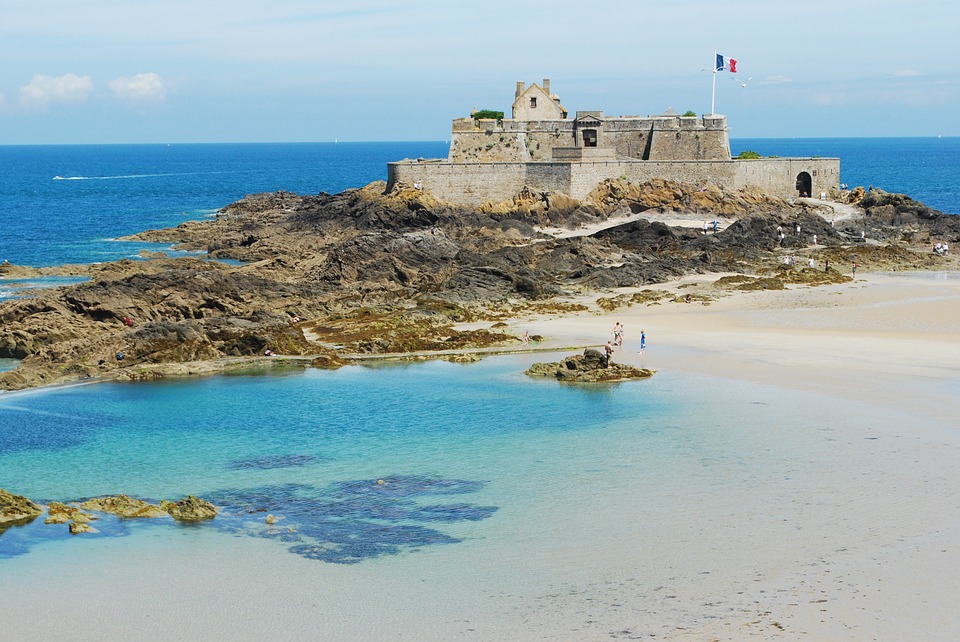
Fort National at St Malo beach (Pixabay)
Fort National, Grand Bé and Petit Bé
Just offshore, Saint-Malo’s tidal islands and forts are among the city’s most distinctive sights. Fort National was constructed in the late 17th century by Garangeau, under the direction of the great military engineer Vauban, to strengthen Saint-Malo’s coastal defenses. It can be reached across Plage de l’Éventail only at low tide, and visits depend on the tides and seasonal opening times.
Grand Bé, reached from Bon Secours Beach at low tide, is best known as the burial place of French writer François-René de Chateaubriand. Farther offshore, Petit Bé is crowned by another 17th-century fort. Always check the tide times before setting out and return well before the access routes are covered by the sea.
Other Places to Visit in Saint-Malo
If you have more time available, you may also like to visit the Grand Aquarium, one of the biggest aquariums in France; the only surviving home of a former Saint-Malo corsair, La Demeure de Corsaire; or the Jacques Cartier Museum, the former farmhouse home of 16th-century explorer Jacques Cartier.
Where to eat in Saint-Malo
For some delicious crepes, try the Crêperie Le Tournesol in the walled city, which is bursting with character. They also do a great cider. For some huge and tasty seafood platters, try L’Ancrage, and for an excellent French bistro that is popular with the locals, head to the Cargo Culte. Their quiches and salads are especially good!
Practical Information: Tides, Parking and Getting There
Saint-Malo is about an hour’s drive from Mont-Saint-Michel, although traffic can lengthen the journey during busy periods. Parking can be challenging, particularly in summer, but France Just For You travelers receive detailed parking and arrival recommendations in their personal guidebook.
Gare de Saint-Malo is served from Paris Montparnasse by direct TGVs and services requiring a change at Rennes; the fastest journeys take about two and a half hours, although schedules should always be checked before traveling.
If you plan to walk to Fort National, Grand Bé, or Petit Bé, check the Saint-Malo tide times before setting out: these sites are accessible only around low tide, and the routes become submerged as the sea returns.
The History of Saint-Malo
Saint-Malo developed from a fortified settlement at the mouth of the Rance into an important French port associated with merchants, explorers, and state-authorized corsairs. Much of the old town was destroyed during fighting in 1944 and carefully reconstructed after World War II, while most of its historic ramparts survived.
The city's position on a rock at the mouth of the Rance estuary has offered the city an excellent natural defence against invaders since pre-Roman times.
Interestingly, the walled city of Saint Malo was in fact named after a Welsh monk and a disciple of St Brendan called Maclovius.
At that time, Brittany was known as Armorica, and many Celts moved there to escape the unrest in Roman Britain across the English Channel.
From the 16th century onwards, Saint Malo became an important port area due to its strategic position on the French coast. It was a convenient stop-off point for commercial ships that were heading south from the North Sea and England and it was also popular with corsairs and explorers.
Corsairs, also known as French privateers, who were essentially state-approved pirates who had the permission of the French government to engage in war against foreign ships to attempt to commandeer them and take them as prizes.
As well as forcing English ships on the Channel to pay a tribute to them, the corsairs of Saint-Malo would bring home riches from far and wide. At this time, piracy was very common and many became rich from their chosen way of life at high sea. The English and Dutch merchant navy would have been prepared for violent encounters with the Saint-Malo corsairs.
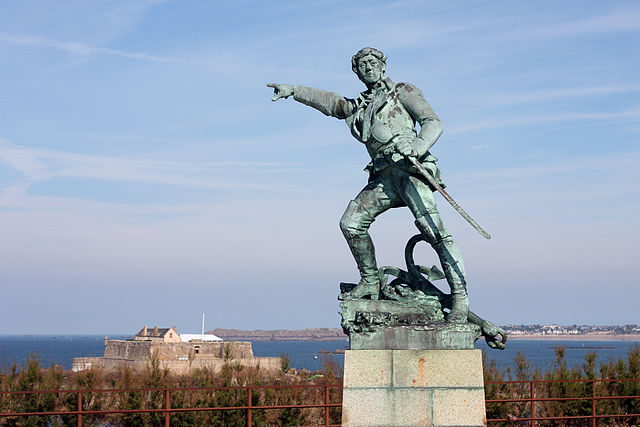
A statue of Robert Surcouf, a Saint-Malo corsair (Guillaume Piolle - C.C. by 3.0)
Departure Point for Voyages to the ‘New World’
Aside from its association with a violent history of piracy, Saint-Malo was also known as a departure point for voyages across the Atlantic Ocean to the ‘New World’.
One of the city’s most famous citizens and explorers, Jacques Cartier, was born there in 1491. On 20th April 1534, he embarked upon a voyage of discovery towards new lands. Eventually he landed on modern day Quebec in Canada, which he named ‘New France’.
If you plan to spend a day in Saint-Malo, you may like to visit the museum La Maison du Québec (The House of Quebec), which is dedicated Jacques Cartier’s discovery. The explorer himself was buried in Saint-Malo Cathedral, also called the Cathedral of St Vincent.
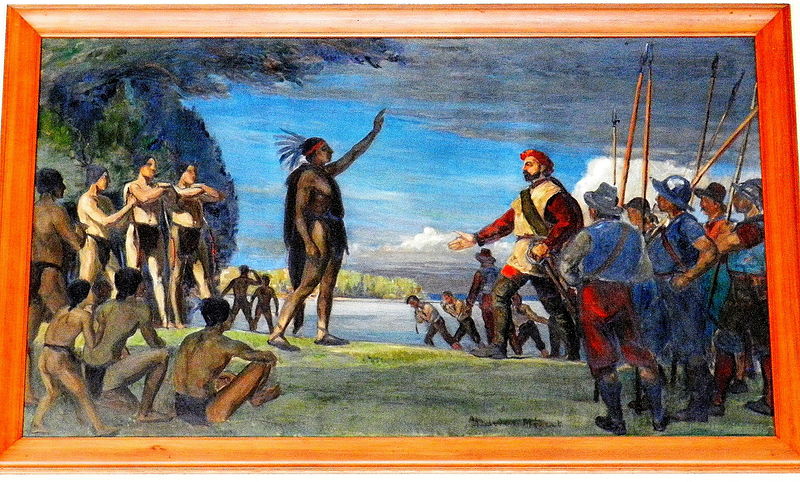
A painting of Jacques Cartier landing in Hochelaga in 1535 (now modern-day Quebec)
Adrien Hébert CCSA by 4.0
Saint-Malo During World War II and Reconstruction
During the fighting of August 1944, much of Saint-Malo’s walled old town was destroyed. Its reconstruction was largely completed by 1957, with architects using traditional materials such as granite and slate to preserve the city’s historic character and distinctive skyline. Although most of the buildings inside Intra-Muros were newly constructed, the result remained remarkably faithful to the appearance of the prewar city.
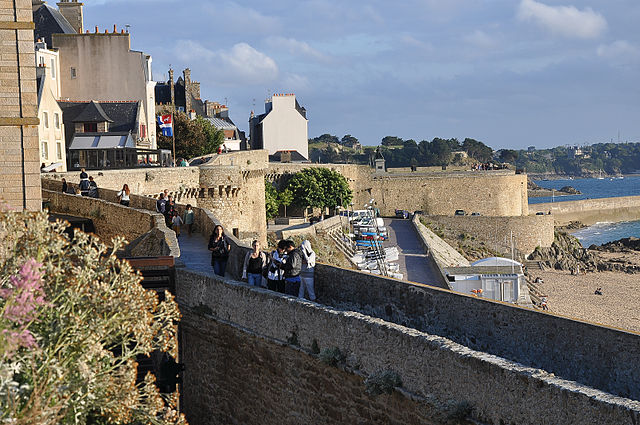
The ramparts enclosing the old town of Saint-Malo (CC by 3.0 Moonik)
Add a day trip to Saint-Malo to one of our Normandy tours or Brittany tours! If you book one of our France tour packages, we can arrange a stop in Saint-Malo as part of your Brittany road trip or our tours of Normandy. It takes about an hour to get there by car from the Mont Saint-Michel area.
FAQs
Is Saint-Malo worth visiting?
Yes. Saint-Malo combines a historic walled city, panoramic ramparts, sandy beaches, and tidal island forts within a relatively compact area. It is particularly worthwhile for travelers exploring Brittany or combining the region with nearby Mont-Saint-Michel. Saint-Malo is a favorite among our travelers to Brittany!
How should you spend one day in Saint-Malo?
Begin in Intra-Muros, visit Saint-Vincent Cathedral, and walk around the ramparts. After lunch in the walled city, visit the beach and, if the tide permits, walk to Fort National or Grand Bé. Finish with time to explore the shops and cafés inside the old town.
How much time do you need in Saint-Malo?
One full day is enough to experience Saint-Malo’s principal sights. Two days will provide more time for the beaches, museums, tidal islands, and nearby destinations such as Cancale or Dinard.
Is Saint-Malo walkable?
Yes. Intra-Muros, the cathedral, ramparts, and nearby beaches can all be explored on foot. The old town has cobbled streets, and parts of the ramparts and island routes involve steps or uneven surfaces, so comfortable shoes are recommended.
If you book one of our Brittany tours, we will include a suggested self-guided walking tour of the town in your personalized France guidebook!
What is Saint-Malo famous for?
Saint-Malo is famous for its fortified old town, historic ramparts, dramatic tides, sandy beaches, and connections with French corsairs and explorer Jacques Cartier.